People often think of different fields as very distinct from each other, partly as a result of the way we learn different subjects in school. Physics is different from chemistry, which is different from biology. Of course that's how it is! We often lose sight of, or never even learn in the first place, how these fields come together and intersect and overlap. If we had a better understanding of how different fields could enhance and affect each other, we would be much better at thinking outside the box and coming up with all sorts of creative solutions to various societal challenges.
For instance, most people (myself included) might not have thought that solar cells (also called "photovoltaics") could be useful for biomedical research applications beyond powering the tools and equipment needed for such research. However, there is a thriving subset of such research that uses photovoltaics and related structures to actually understand cells better. This is possible in part because solar cells are not always large, dark-blue panels that we can see without a microscope, as pictured below [1].
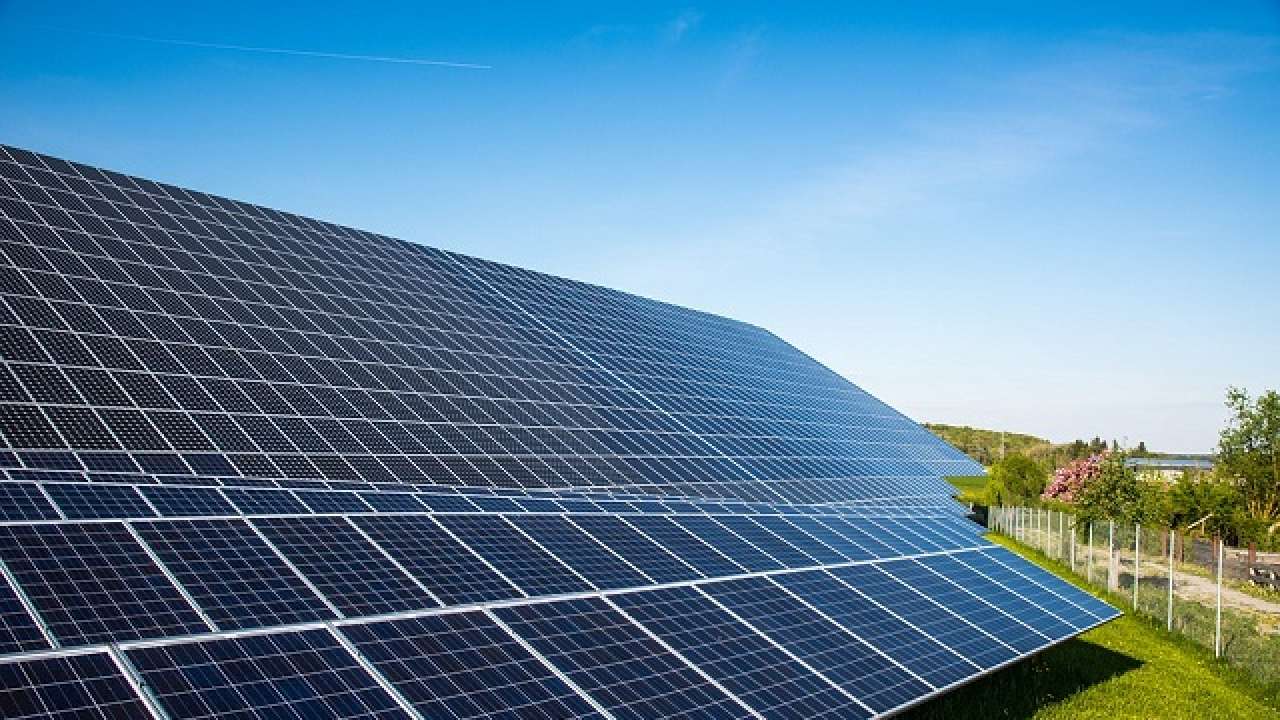
These solar cells with which we are familiar are flat and generally made of silicon (Si). However, solar cells can be made of other materials too. Some of these materials include other inorganic semiconductors similar to silicon, such as gallium arsenide (GaAs) and indium phosphide (InP), which do not contain carbon. Other materials, such as carbon-containing (or organic) semiconductors and perovskites, allow for thin-film cells that could form flexible photovoltaics or be manufactured more easily. For small-scale purposes and applications, they could also be made from materials that are only a few atomic-layers thick, which make them effectively two-dimensional, or be made of nanowires whose diameters are 100 times thinner than a human hair. It is this last class of solar cell structures that this post will focus on for its applications in cell research.
For starters, the geometry of a nanowire array alone is quite useful in studying cells. Below is a picture of a nanowire array where the wires are 30 micrometers (30*10^-6 m) long, the diameter of each wire is 175 nm (1.75*10^-9 m), and the distance between the wires is 300 nm [2]:

These arrays, regardless of whether they are photovoltaics or not, are useful for growing and manipulating cells. Nanowires can help cells stick to the surface better, and some cells can survive better on nanowire surfaces [3]. Different cells are affectedly differently by the material and structure of the surface; one study of normal and cancerous human breast cells showed that fewer of these cells divided on a surface made of a semiconductor called gallium phosphide (GaP) than on glass, but that on flat geometries, normal cells had similar cell cycle times regardless of material [4]. The exact geometry of the nanowire array, such as the diameter of each wire, nanowire length, and distance between the nanowires, can help affect cell shape, population growth, ability to stick to surfaces, and movement [5]. They can even measure cells' activity and the forces between different cells [5]!
The properties of nanowires can be tweaked and manipulated in order to use them as light sources or solar cells. For reasons that are too long to get into in this post, creating a structure with different types of and concentrations of impurities in different regions creates the core of a structure that can be used to generate light like an LED, turn light into electricity like a solar cell, or switch current on and off like a transistor. Different applications require us to optimize geometries and parameters differently, so that the final structure of a good LED looks very different from the final structure of a good solar cell, but many of the underlying principles are the same. Below is a diagram of this commonly-used core unit, called a p-i-n junction [6]:
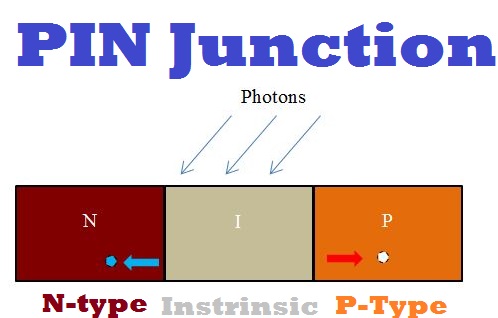
A lot of times, interactions between atoms involve the outermost electrons of atoms called valence electrons. A p-i-n junction involves three different regions, each with different types of impurities that we choose to add. The p-type region has intentional impurities whose atoms have fewer valence electrons than the base material. The i-type (intrinsic) region has no (intentional) impurity atoms, and the n-type region has intentional impurity atoms with more valence electrons than the base material. With this structure, shining a light source on it can generate electricity, putting a voltage across this structure can generate light, and further manipulation can create a structure that can quickly switch current on and off.
Why is all this relevant to cell research? Well, cells can generate electricity and light themselves, as well as respond to light. Therefore, using nanowires as transistors (like in our computers) can help measure electrical signals from cells, and using them as LEDs can help manipulate individual light-sensitive cells. The underlying similarity in the physics of operation between LEDs and photovoltaics motivates the use of nanowire solar cells as a tool for biomedical research. Solar cells are a type of photodiode, a device that converts light into electricity. However, depending on the specific application, a photodiode can be optimized to maximize the energy generated in a given amount of time (as in a solar cell), maximize sensitivity to light (as in sensors), or other criteria.
One study looked at how the electrical activity of cells surrounding photovoltaic nanowires could be modulated (switched back and forth) using light [7]. By creating a cylindrical wire with a p-type core, i-type middle shell, and n-type outer shell, these scientists obtained a solar-cell structure in which electrons would go towards the outer surface when light shone on the nanowire and surrounding cells, but would stay where they were when the light was turned off [7]. Below is a picture of the structure of one of these wires [8]:

The structure of the wires used in this research is similar to the ones pictured above, except they're made of silicon instead of GaAs and the n and p regions are switched so that the n shell is on the outside [7]. The concentration of electrons at the surface of the wire, which changed depending on whether there was light or not, would affect the electrical activity of the cells [7]. The advantage of this system over other methods used in cell research is that it can help target single cells, is not as bulky, and does not require invasive procedures on the cells such as genetically modifying them to react to light, which can be difficult to implement [7].
Another study looked at using silicon nanowire array structures to control the activity of retinal neurons, which are cells in our eyes that can be excited with electricity and communicate with other cells using electrical and chemical signals [9]. Using these nanowire structures allowed control over these cells using both electricity and light, which important because the cells in our eyes need to be sensitive to light in order to let us see [9]. This has exciting applications for retinal prostheses, which are devices that can help people who have lost their vision due to retinal diseases that ruin the eye's ability to detect light [10]. Because photodiodes are devices whose generated electricity is sensitive to incoming light, using nanowire array photodiodes can help achieve a high-resolution replacement for some of our eyes' functions.
Nanowire photodiodes can even affect cells that do not produce electricity on their own. This study looked at lung cancer cells on nanowires arrays made of indium phosphide (InP), a material I am studying in my own nanowire solar cell research for making photovoltaics that will do well in the harsh environment of outer space [5]. After growing the cells on the nanowire array, the researchers determined the properties of these cells using an imaging technique called immunofluorescence [11]. Immunofluorescence involves tweaking light-emitting dyes so that they target the parts of cells that fight off attackers [11]. They found that shining light on cells grown on nanowire photodiode arrays reduced the multiplication of these cancerous cells compared to when the light was shut off [5]. Being able to use light to switch the rate at which these cells multiply is very helpful for cancer research. Many times, cancer can end up lying dormant, in which case it is not multiplying and spreading in the moment but can do so at a later time if environmental conditions change to make such multiplication favorable. By using these arrays to force cancer cells to become dormant, scientists can more easily study treatments to reverse or prevent said dormancy so that treatment can get rid of the cancer once and for all [5].
The examples mentioned above only begin to scratch at the surface of all the exciting possibilities for using nanowire photodiodes to advance biomedical research and develop treatments for a variety of ailments. However, it is important to point out where the specific applications cause research in related areas to diverge. The most important point is that the specific application dictates the criteria for which we optimize. For instance, in photovoltaics we care about maximizing power generation efficiency, and it's usually more efficient and easier to make and use axial wire structures where the p, i, and n regions are stacked on top of each other, as pictured below [8]:

However, if we want cells to surround the wires and want electrons and the surface of the wire to depolarize the surrounding cells and make them react to light without genetically modification, a radial structure is necessary for this application, so that the electrons can go to the outer shell and the electron vacancies left behind, called holes, can redistribute themselves to the inner core [7]. Similarly, for retinal prosthesis we want ultra-high sensitivity above all and potentially different sensitivity to different wavelengths of light in order to mimic the cones in our eyes and help see color, while in a solar cell we would want to extract as much power as possible from each wavelength of light. Thus, a lot of the optimization work would look drastically different for researchers in these various fields, and even the researchers working on biomedical applications would not all be aiming for the same nanowire characteristics.
So in short, there is a surprising amount of overlap between various fields that we would normally think of as very distinct. While the end goals may be very different for different fields and applications, there are common challenges underlying them. Medical researchers, for instance, have reason to pay attention to challenges and advances that materials scientists may face with working with different materials for nanowire production, while applied physicists should pay attention to the needs of the biomedical community as well as the way they may use and improve nanowires' electrical and optical performance for applications they often do not consider. By building off of each other, these different fields can really come up with creative solutions to various challenges and advance technology more than each could do if restricted to itself.
Sources
[1] New type of washable solar cell developed
[2] Extracting Individual Properties from Global Behavior: First-order Reversal Curve Method Applied to Magnetic Nanowire Arrays
[3] Gallium phosphide nanowires as a substrate for cultured neurons
[4] Single cell analysis of proliferation and movement of cancer and normal-like cells on nanowire array substrates
[5] Photovoltaic nanowires affect human lung cell proliferation under illumination conditions
[6] Introduction to Photodiode
[7] Photoelectrochemical modulation of neuronal activity with free-standing coaxial silicon nanowires
[8] Optimization of GaAs Nanowire Pin Junction Array Solar Cells by Using AlGaAs/GaAs Heterojunctions
[9] Towards high-resolution retinal prostheses with direct optical addressing and inductive telemetry
[10] Retina prosthesis
[11] Immunofluorescence
Comments
Post a Comment