The Sun is an incredibly powerful source of energy. It can heat us up, burn our skin, light up the outdoors, and sustain all of life as we know it. Without the Sun, most plants would not be able to survive, which would deprive animals of their much-needed food and eventually hurt even those of us with carnivorous diets. If we could harness all the energy that the Sun pours on us daily for free, we could fulfill the entire world's power needs many times over! The infographic below illustrates the world's energy demand as well as the energy potential of solar power compared to various other renewable and nonrenewable energy sources [1]:
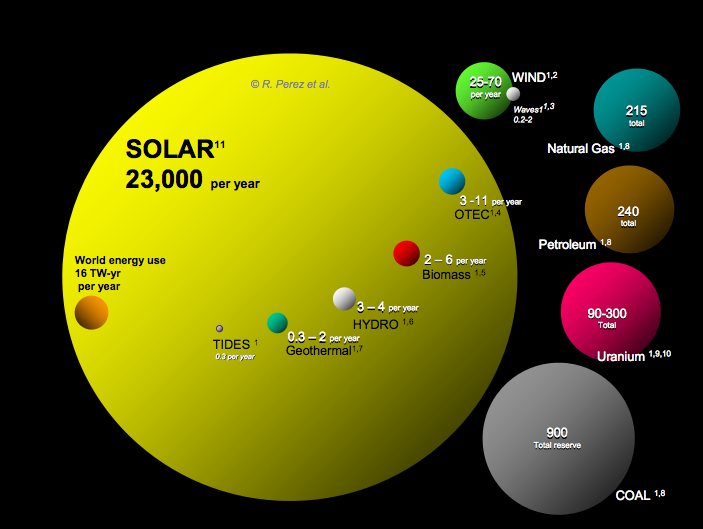
Even after counting all the sunlight that is absorbed or reflected by our atmosphere and clouds, the Sun produces over 1400x the amount of energy per year than all the humans around the world consume during this same amount of time [1].
It is difficult to take advantage of this valuable resource for many reasons. However, the biggest roadblock to greater widespread use even in states like California and Texas is the intermittency of sunlight. The Sun does not shine 24/7 365 days a year — what do we do when it doesn't shine? This intermittency is a large part of what prevents even sunny states from using solar energy as their primary source of power. Solar generation during the daytime is not a problem in these states — even with current consumer-grade technology, California generates enough usable electricity during the daytime that it sometimes has to pay other states to take it! [2] When night falls, however, Californians are no better off than Ohioans unless they can come up with a way to store the large amounts of excess energy needed to sustain its population through the darkness.
Solar fuels provide a potentially promising solution to this problem. By replicating the process of photosynthesis, used by plants to turn carbon dioxide (CO2) into oxygen (O2) and store the energy it generates as food for itself, we can potentially store a lot of energy in a small volume [3]. The figure below illustrates a schematic of this "artificial photosynthesis" [4]:
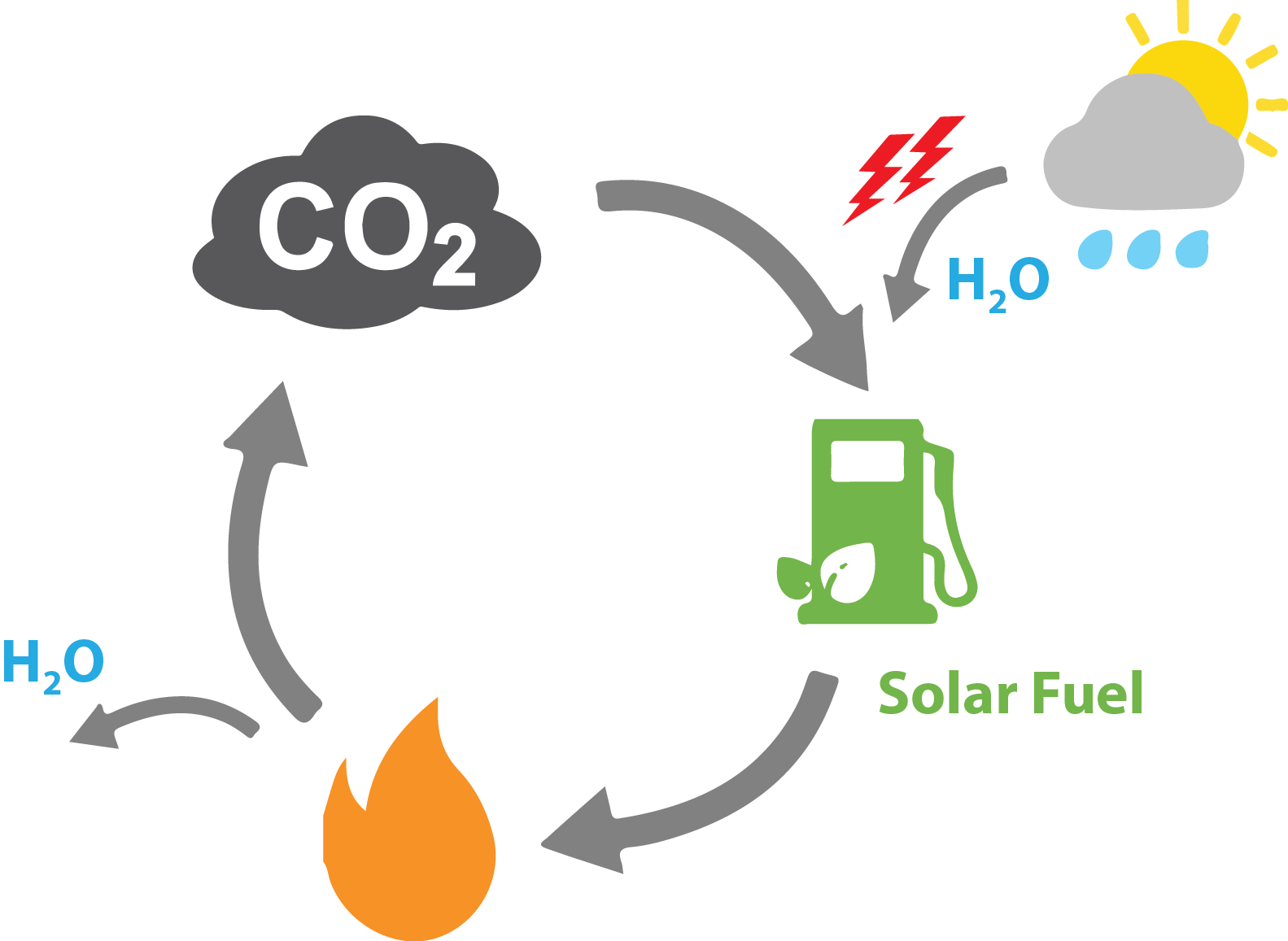
In the figure, we can see that CO2 and water (H2O) combine in the presence of sunlight to make fuels, which can then be burned for energy. The CO2 that these fuels will release can, instead of building up in the atmosphere, be used again to make more fuel. This not only helps us store solar energy but does so by using CO2 to do so. It uses the same resource that solar cells do but fills the intermittency gap so that we can continue to use the energy from sunlight even when it is dark. At the moment, liquid fuels are superior to batteries when it comes to storing large amounts of energy in small volumes [3]. By using sunlight to generate a renewable source of liquid energy through this "artificial photosynthesis", we can potentially transform all of transportation and power it cleanly! [5]
Recognizing the potential that solar fuels promise, the Department of Energy (DOE) established the Joint Center for Artificial Photosynthesis (JCAP) 10 years ago to lay the foundation for creating scalable technology that would accomplish what I have described before [6]. Specifically, it aimed to find a catalyst, which is a material that helps a chemical reaction occur without being eaten up by that reaction, that could help turn sunlight, CO2, and water into alkanes (used in gasoline), alkenes (used in plastic manufacturing), and primary alcohols [5]. JCAP has had many successes, including improving the efficiency of conversion steps in the solar-to-chemical energy process from < 1% to 19% and "designing highly stable solar-fuels generators" [3].
Leapfrogging off of the successes of JCAP, the DOE is funding two new programs: the Liquid Sunlight Alliance (LiSA), which aims to streamline and improve the efficiency of the artificial photosynthesis process, and the Center for Hybrid Approaches in Solar Energy to Liquid Fuels (CHASE), which will combine different materials and molecules to develop hybrid components that absorb light and convert it into fuel within one system [3]. Specifically, LiSA will study the interactions of the catalysts with their surrounding environment and work to control the system at a molecular level so that the necessary reactions can happen in abundance exactly how we want them [7]. It will accomplish this by using computational theory work and real-time observations using imaging tools such as ultra-fast x-rays [3]. CHASE, meanwhile, will also work to come up with new design principles for these systems [8].
Even after counting all the sunlight that is absorbed or reflected by our atmosphere and clouds, the Sun produces over 1400x the amount of energy per year than all the humans around the world consume during this same amount of time [1].
It is difficult to take advantage of this valuable resource for many reasons. However, the biggest roadblock to greater widespread use even in states like California and Texas is the intermittency of sunlight. The Sun does not shine 24/7 365 days a year — what do we do when it doesn't shine? This intermittency is a large part of what prevents even sunny states from using solar energy as their primary source of power. Solar generation during the daytime is not a problem in these states — even with current consumer-grade technology, California generates enough usable electricity during the daytime that it sometimes has to pay other states to take it! [2] When night falls, however, Californians are no better off than Ohioans unless they can come up with a way to store the large amounts of excess energy needed to sustain its population through the darkness.
Solar fuels provide a potentially promising solution to this problem. By replicating the process of photosynthesis, used by plants to turn carbon dioxide (CO2) into oxygen (O2) and store the energy it generates as food for itself, we can potentially store a lot of energy in a small volume [3]. The figure below illustrates a schematic of this "artificial photosynthesis" [4]:
In the figure, we can see that CO2 and water (H2O) combine in the presence of sunlight to make fuels, which can then be burned for energy. The CO2 that these fuels will release can, instead of building up in the atmosphere, be used again to make more fuel. This not only helps us store solar energy but does so by using CO2 to do so. It uses the same resource that solar cells do but fills the intermittency gap so that we can continue to use the energy from sunlight even when it is dark. At the moment, liquid fuels are superior to batteries when it comes to storing large amounts of energy in small volumes [3]. By using sunlight to generate a renewable source of liquid energy through this "artificial photosynthesis", we can potentially transform all of transportation and power it cleanly! [5]
Recognizing the potential that solar fuels promise, the Department of Energy (DOE) established the Joint Center for Artificial Photosynthesis (JCAP) 10 years ago to lay the foundation for creating scalable technology that would accomplish what I have described before [6]. Specifically, it aimed to find a catalyst, which is a material that helps a chemical reaction occur without being eaten up by that reaction, that could help turn sunlight, CO2, and water into alkanes (used in gasoline), alkenes (used in plastic manufacturing), and primary alcohols [5]. JCAP has had many successes, including improving the efficiency of conversion steps in the solar-to-chemical energy process from < 1% to 19% and "designing highly stable solar-fuels generators" [3].
Leapfrogging off of the successes of JCAP, the DOE is funding two new programs: the Liquid Sunlight Alliance (LiSA), which aims to streamline and improve the efficiency of the artificial photosynthesis process, and the Center for Hybrid Approaches in Solar Energy to Liquid Fuels (CHASE), which will combine different materials and molecules to develop hybrid components that absorb light and convert it into fuel within one system [3]. Specifically, LiSA will study the interactions of the catalysts with their surrounding environment and work to control the system at a molecular level so that the necessary reactions can happen in abundance exactly how we want them [7]. It will accomplish this by using computational theory work and real-time observations using imaging tools such as ultra-fast x-rays [3]. CHASE, meanwhile, will also work to come up with new design principles for these systems [8].
LiSA will be led by Harry Atwater at Caltech, while CHASE will be led by the University of North Carolina at Chapel Hill. Both initiatives will involve partnership with DOE national labs such as Lawrence Berkeley National Laboratory, SLAC National Accelerator Laboratory, and the National Renewable Energy Laboratory.
Sources
[5] Why Solar Fuels
[6] JCAP, Who We Are
Comments
Post a Comment